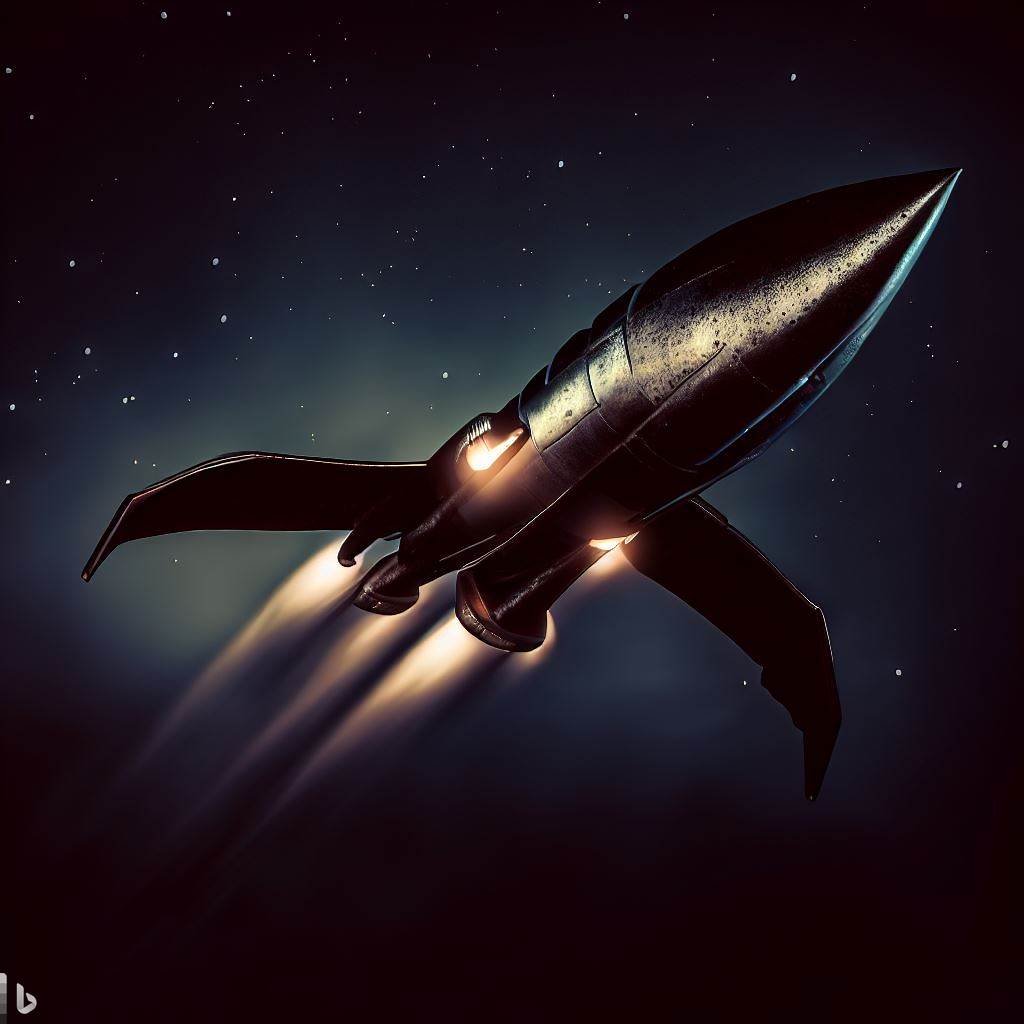
The 1940s Ghost Rocket Sightings
The ghost rocket sightings of the 1940s refer to a series of unidentified aerial phenomena reported primarily in Scandinavia, specifically Sweden, during the years following World War II. These sightings gained significant attention and sparked a wave of intrigue and speculation, leading to extensive investigations by government agencies and scientific organizations.
The first reported ghost rocket sighting occurred on February 26, 1946, near the town of Bollnäs, Sweden, when a local resident witnessed a rocket-like object soaring through the sky. Over the next few months, numerous similar sightings were reported across Sweden, as well as in neighboring countries such as Norway and Finland. Witnesses described seeing elongated, cigar-shaped objects with no visible wings or propellers, emitting a strange whistling or humming sound as they flew overhead.
The frequency of sightings peaked in the summer of 1946, with hundreds of reports pouring in from all over the region. Witnesses included military personnel, pilots, radar operators, and civilians. The objects were often observed flying in formation or performing unusual maneuvers, such as sudden changes in direction or altitude. Some witnesses even reported seeing smaller objects being released or detached from the larger ones.
The Swedish military took the sightings seriously and launched an investigation to determine the origin and nature of the ghost rockets. The military’s initial assumption was that these sightings were the result of Soviet missile tests or reconnaissance flights. Sweden was neutral during World War II, and the government was particularly concerned about potential violations of their airspace.
A joint Swedish-Finnish commission was formed to study the phenomenon, which included military officers, scientists, and experts in aviation. Their investigation involved collecting witness testimonies, analyzing radar data, and examining debris that was occasionally recovered from alleged crash sites. However, despite extensive efforts, no concrete evidence or satisfactory explanation for the sightings could be found.
International media attention grew, and the ghost rocket phenomenon became a subject of great interest worldwide. Many theories were put forward to explain the sightings, ranging from Soviet missile tests and secret weapons to extraterrestrial spacecraft and even psychological mass hysteria.
In response to the mounting pressure, the Swedish government increased its efforts to solve the mystery. The military conducted more rigorous investigations, and the Swedish Air Force deployed additional resources to monitor the skies. The United States also became involved, sending a team of experts from the U.S. Air Force and the Office of Naval Intelligence to collaborate with the Swedish investigation.
Despite the combined efforts, no definitive conclusion was reached regarding the nature of the ghost rockets. The sightings gradually diminished in late 1946, and by the early 1950s, they had largely subsided. The official position of the Swedish government was that the majority of sightings could be explained by natural phenomena, such as meteors, atmospheric disturbances, and misidentifications of conventional aircraft.
To this day, the ghost rocket sightings of the 1940s remain a mystery. While some skeptics argue that the sightings were a result of misperceptions or Cold War paranoia, others believe that the phenomenon may have had genuine extraterrestrial or otherworldly origins. The ghost rockets continue to be a subject of interest for UFO researchers and enthusiasts, representing one of the most intriguing and enduring unsolved cases in the history of unidentified aerial phenomena.
Other UFO Sightings in Europe
- Rendlesham Forest Incident (United Kingdom, 1980): Often referred to as “Britain’s Roswell,” this incident involved multiple U.S. military personnel witnessing a series of unexplained lights and a landed craft in Rendlesham Forest, Suffolk.
- Belgian UFO Wave (Belgium, 1989-1990): Over a period of several months, numerous sightings of large, triangular-shaped UFOs were reported in Belgium. The wave gained significant media coverage and prompted investigations by the Belgian military.
- Tunguska Event (Russia, 1908): While the exact cause of the Tunguska Event remains a mystery, some theories suggest it was a result of a UFO crash or an atmospheric explosion caused by an alien spacecraft. The event occurred in a remote region of Russia and devastated a large area of the Siberian forest.
- Kaikoura Lights (New Zealand, witnessed by European pilots, 1978): Although the sighting occurred in New Zealand, it involved European pilots. While flying over the Kaikoura Mountains, the pilots witnessed a series of unidentified lights, which were also captured on camera.
- The Berwyn Mountain Incident (Wales, United Kingdom, 1974): In this incident, residents reported hearing a loud explosion and seeing strange lights in the sky above the Berwyn Mountains. Some witnesses claimed to have seen a crashed UFO and military personnel in the area.
- Västerås UFO Incident (Sweden, 1946): This incident involved a Swedish military radar operator tracking an unknown object moving at high speeds. The object appeared to defy conventional aircraft capabilities and disappeared without a trace.
- Trans-en-Provence Case (France, 1981): A farmer in Trans-en-Provence witnessed a saucer-shaped object landing in his field. Physical evidence, such as soil samples and traces of heat, were collected and analyzed by experts.
- Eupen Incident (Belgium, 1989): In this case, a Belgian army captain reported seeing a large, triangular UFO hovering over the Eupen region. The object emitted a bright light and exhibited rapid movements.
- Falkirk Triangle (Scotland, United Kingdom, ongoing): The Falkirk Triangle is an area in central Scotland known for frequent UFO sightings. Witnesses have reported seeing strange lights, triangular-shaped objects, and unexplained aerial phenomena in this region.

