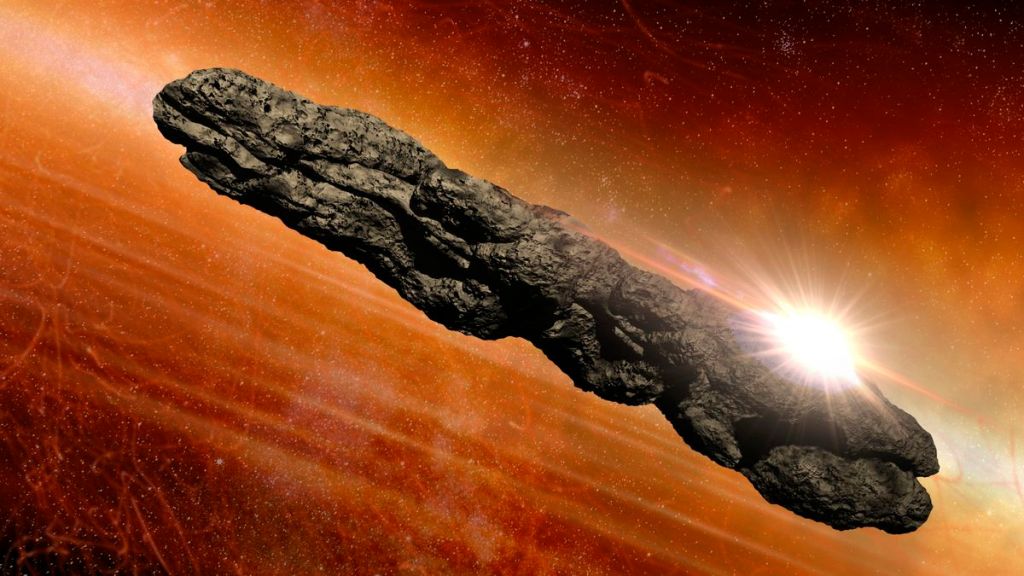
Was Oumuamua an alien spacecraft?
In October 2017, astronomers detected a peculiar object traversing our solar system. Named ‘Oumuamua, a Hawaiian term meaning “a messenger from afar arriving first,” this interstellar visitor exhibited characteristics unlike any comet or asteroid previously observed. Its elongated, cigar-like shape and unexpected acceleration as it moved away from the Sun sparked intense debate about its origins and nature.
Competing Theories on ‘Oumuamua’s Origin
- Natural Origins:
- Cometary Activity: Some scientists proposed that ‘Oumuamua was a comet emitting gas jets that caused its acceleration. However, the absence of a visible coma or tail challenged this idea.
- Hydrogen Iceberg: Another hypothesis suggested that ‘Oumuamua was composed of molecular hydrogen ice, allowing it to sublimate without detectable emissions. Subsequent studies, however, questioned the stability of such icebergs in interstellar space.
- Fragment from a Pluto-like Exoplanet: Researchers Steven Desch and Alan Jackson posited that ‘Oumuamua could be a fragment from a Pluto-like exoplanet, composed of nitrogen ice. This composition might explain its reflective surface and unusual acceleration due to nitrogen sublimation.
- Artificial Origin:
- Extraterrestrial Probe: Harvard astronomer Avi Loeb suggested that ‘Oumuamua might be an artificial object, possibly a light sail from an alien civilization, due to its shape, reflective properties, and unexplained acceleration.
Avi Loeb and the Galileo Project
In response to the ambiguity surrounding ‘Oumuamua and other unidentified aerial phenomena (UAP), Avi Loeb initiated the Galileo Project. This endeavor aims to systematically search for evidence of extraterrestrial technological artifacts. Unlike traditional SETI efforts that focus on electromagnetic signals, the Galileo Project seeks physical objects associated with extraterrestrial technology.
Mission and Findings of the Galileo Project
The Galileo Project’s objectives include:
- Monitoring the Skies: Deploying a network of telescopes and sensors to capture high-resolution data on UAPs.
- Analyzing Interstellar Objects: Studying objects like ‘Oumuamua to assess their nature and potential artificial origins.
- Searching for Alien Satellites: Identifying unusual satellites or debris in Earth’s orbit that could be of extraterrestrial origin.
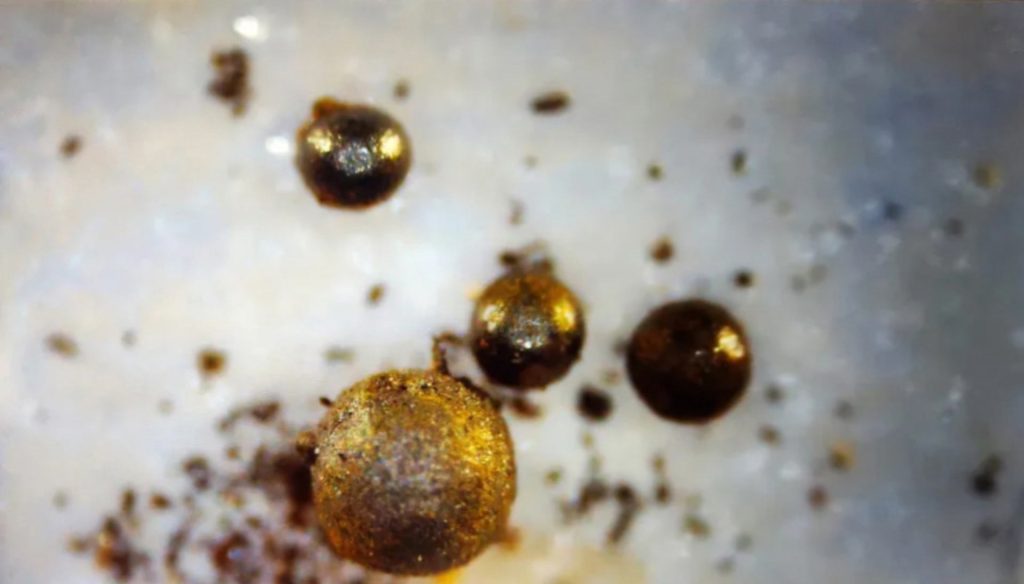
One notable endeavor involved an expedition to the Pacific Ocean to retrieve spherules from the first recognized interstellar meteor, IM1. Over 50 sub-millimeter-sized spheres were collected from the ocean floor along IM1’s projected path. Early analysis indicated that some spherules contained unusually high abundances of elements like Beryllium, Lanthanum, and Uranium, suggesting a potential extrasolar origin.
The true nature of ‘Oumuamua remains an open question in the scientific community. While natural explanations address some of its peculiar characteristics, none fully account for all observed phenomena. Avi Loeb’s Galileo Project exemplifies the pursuit of rigorous scientific inquiry into such anomalies, striving to determine whether they signify natural cosmic occurrences or potential evidence of extraterrestrial technology.
 ALIEN BLUE BOOK