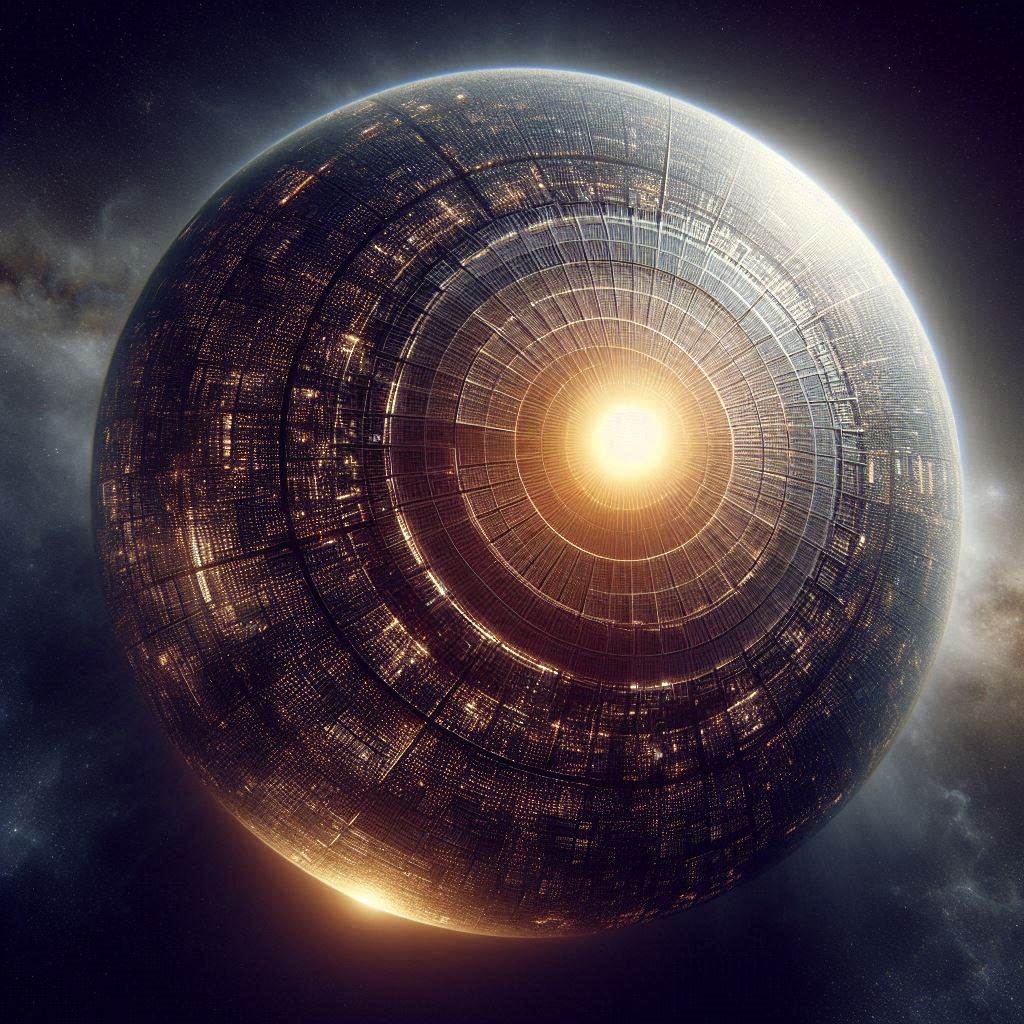
Searching for Advanced Civilizations: The Hunt for Dyson Spheres
In the vast expanse of the cosmos, human curiosity continually pushes the boundaries of what we understand about the universe and our place within it. One concept that has captivated scientists and science fiction enthusiasts alike is the Dyson Sphere. This intriguing theoretical structure offers a glimpse into the potential future of energy harnessing and advanced civilization.
The Origins of the Dyson Sphere
The concept of the Dyson Sphere was first introduced by the British-American theoretical physicist and mathematician Freeman Dyson in 1960. In his seminal paper titled “Search for Artificial Stellar Sources of Infrared Radiation,” Dyson proposed that a highly advanced civilization could theoretically construct a massive structure around a star to capture and utilize its energy output.
Dyson’s inspiration stemmed from the Kardashev Scale, a hypothetical framework developed by Russian astrophysicist Nikolai Kardashev in 1964 to classify civilizations based on their energy consumption. The Kardashev Scale outlines three types of civilizations:
- Type I: A civilization capable of harnessing all the energy available on its home planet.
- Type II: A civilization capable of capturing all the energy output of its star.
- Type III: A civilization capable of controlling energy on a galactic scale.
Dyson’s idea primarily focuses on a Type II civilization, which would require an immense structure to capture the vast energy emitted by a star.
The Theory Behind Dyson Spheres
At its core, a Dyson Sphere is a hypothetical megastructure that completely encompasses a star, capturing its energy output for use by an advanced civilization. There are several variations of the Dyson Sphere concept, each with its own design and theoretical implications:
- Dyson Swarm: This is the most feasible and widely accepted version of the Dyson Sphere. Instead of a solid shell, a Dyson Swarm consists of a vast array of satellites or solar collectors orbiting the star in a dense formation. These satellites would capture the star’s energy and transmit it to a central location for use.
- Dyson Shell: A solid shell completely surrounding the star. This version is often depicted in science fiction but presents significant engineering challenges, including immense material requirements and structural integrity concerns.
- Dyson Bubble: Similar to the Dyson Swarm, the Dyson Bubble consists of a network of lightweight solar sails or mirrors that form a spherical arrangement around the star. These structures would capture solar energy and redirect it to a central hub.
Scientific Feasibility
While the concept of Dyson Spheres is fascinating, their construction poses immense technological and engineering challenges. Some key considerations include:
- Material Requirements: The amount of material required to build even a Dyson Swarm is staggering. Harvesting and transporting these materials would necessitate advanced space mining and manufacturing capabilities.
- Energy Transmission: Efficiently transmitting the captured energy back to the civilization’s home planet or other locations would require innovative energy transmission technologies, such as microwave or laser beams.
- Heat Dissipation: A Dyson Sphere or Swarm would need to address the issue of heat dissipation to avoid overheating and damaging the structure.
- Structural Integrity: Building a solid Dyson Shell would require materials with exceptional strength and durability to withstand gravitational forces and potential impacts from space debris.
Despite these challenges, the idea of Dyson Spheres remains an intriguing thought experiment that pushes the boundaries of our understanding of future technologies and civilization.
Cultural Impact
The concept of Dyson Spheres has left an indelible mark on science fiction literature, films, and video games. Notable examples include:
- Literature: Dyson Spheres have been featured in numerous science fiction novels, including Larry Niven’s “Ringworld,” which explores the concept of a ring-shaped structure around a star.
- Films: The idea of harnessing stellar energy has been depicted in movies like “Star Trek: The Next Generation,” where the crew encounters a Dyson Sphere.
- Video Games: Video games such as “Stellaris” and “Dyson Sphere Program” allow players to construct and manage Dyson Spheres, offering a glimpse into the potential future of space exploration and energy utilization.
Searching for Dyson Spheres
Detecting Dyson Spheres involves looking for specific signatures that these megastructures would produce. Here are some of the primary methods scientists use in the search for Dyson Spheres:
- Infrared Excess: One of the most promising techniques involves searching for excess infrared radiation. A Dyson Sphere would absorb a star’s light and re-emit it as heat, producing a distinctive infrared signature. By examining the infrared output of stars, astronomers can identify anomalies that may indicate the presence of a Dyson Sphere.
- Stellar Dimming: Another method involves monitoring stars for unusual dimming patterns. If a star is partially or fully surrounded by a Dyson Sphere or Swarm, it would exhibit irregular dimming as the structures pass in front of the star, similar to how exoplanets are detected.
- Spectral Analysis: Advanced civilizations using Dyson Spheres might also produce detectable changes in the star’s spectrum. By analyzing the light from stars, astronomers can look for spectral anomalies that suggest the presence of artificial structures.
- Search for Alien Pollutants: If a Dyson Sphere civilization engages in industrial activities, it might release pollutants or specific chemicals into its star’s atmosphere. Detecting these unusual chemical signatures could be another way to identify advanced civilizations.
Recent Efforts and Discoveries
In recent years, several significant efforts have been made to search for Dyson Spheres. Projects like the Wide-field Infrared Survey Explorer (WISE) and the Gaia mission have provided valuable data for astronomers. Here are some notable examples:
- WISE Data: The WISE mission conducted an all-sky survey in infrared wavelengths, providing a wealth of data that can be analyzed for infrared excesses. Researchers have used this data to search for potential Dyson Spheres, examining thousands of stars for unusual infrared signatures.
- Gaia Mission: The Gaia spacecraft, launched by the European Space Agency, is mapping the positions and motions of over a billion stars. This detailed catalog allows astronomers to search for stars exhibiting unusual dimming patterns or spectral anomalies.
- KIC 8462852 (Tabby’s Star): One of the most intriguing candidates for a possible Dyson Sphere is KIC 8462852, also known as Tabby’s Star. This star exhibits irregular and significant dimming, leading some to speculate that it might be surrounded by a Dyson Swarm or other megastructure. While natural explanations such as dust clouds are more likely, Tabby’s Star remains a subject of ongoing research and interest.
- Project Hephaistos: A recent publication from this project has created a technique to search the skies for signs of a Dyson Sphere. After all of the filters were applied to all of the sky objects, the project identified seven possible structures that could approximate Dyson Spheres.
The Implications of Finding a Dyson Sphere
The discovery of a Dyson Sphere would be a monumental event in human history, providing definitive evidence of intelligent extraterrestrial life. Such a finding would have profound implications:
- Technological Advancement: Detecting a Dyson Sphere would indicate that advanced civilizations have overcome significant technological and engineering challenges, providing insights into possible future advancements for humanity.
- Philosophical Impact: Discovering intelligent life would challenge our understanding of our place in the universe, prompting profound philosophical and existential questions about the nature of life and civilization.
 ALIEN BLUE BOOK